
Understanding the PSA Oxygen Generation Process
Pressure Swing Adsorption (PSA) is the dominant technology for on-site oxygen generation at hospitals, industrial facilities, and commercial oxygen bottling plants worldwide. The PSA process exploits the ability of zeolite molecular sieves to selectively adsorb nitrogen from compressed air at elevated pressure, allowing oxygen-enriched gas to pass through. When the sieve bed is saturated with nitrogen, pressure is reduced (swung), releasing the nitrogen and regenerating the bed for the next adsorption cycle.
A PSA oxygen plant using compressed air includes four essential sub-systems: the air compression system, the pre-treatment train (drying and filtration), the PSA sieve bed assembly, and the product oxygen buffer and distribution system. Of these, the air compression system represents the largest capital investment, the highest energy consumption, and the most maintenance-intensive component. Getting the air compressor specification right for PSA oxygen plant service is therefore the single most consequential technical decision in PSA plant design.
PSA oxygen plant showing feed air compressor, dryer, sieve vessels, and product oxygen buffer
In a PSA oxygen plant, the air compressor accounts for 60-70% of total system power consumption. A 1% improvement in compressor specific power (kW per Nm3/h) translates directly to significant energy cost savings over the plant lifetime.
Air Compressor Requirements for PSA Oxygen Plants
Absolute Oil-Free Operation
This is the primary requirement and there are no exceptions. Oil vapor entering the zeolite sieve beds causes irreversible adsorption capacity loss. Even oil mists below the ISO 8573-1 Class 1 limit cause cumulative degradation. Only certified ISO 8573-1 Class 0 oil-free compressors are acceptable.
Continuous Duty Rating
PSA oxygen plants for hospital or industrial service must run 24 hours per day, 365 days per year. The air compressor must be rated for continuous duty without mandatory rest periods. Intermittent-duty machines are not acceptable for this application.
N+1 Redundancy
Critical oxygen applications — hospital oxygen plants, industrial processes with no alternative supply — must include standby compressor capacity so that a single compressor failure does not interrupt oxygen supply.
Stable Discharge Pressure
PSA sieve beds perform best with stable feed pressure. Excessive pressure fluctuation from the compressor reduces oxygen purity and shortens sieve life. Variable frequency drive control improves pressure stability and reduces cycling.
Low Moisture Carryover
Discharge air moisture must be minimized to reduce the load on the downstream air dryer. Integrated aftercooling and moisture separation are standard on oil-free compressors for PSA oxygen plant service.
Vibration Isolation
Excessive compressor vibration can disturb zeolite granules in the sieve beds, increasing pressure drop and reducing bed performance. Mount air compressors on anti-vibration pads and use flexible hose connections to sieve vessels.
| Requirement | Benchmark Value |
|---|---|
| Air quality class | ISO 8573-1 Class 0 oil, Class 2 water, Class 2 particles (minimum) |
| Discharge pressure | 4.5-7.5 bar (typical; varies with sieve bed pressure rating) |
| Flow capacity | 3.5-5 Nm3 air per Nm3/h of rated O2 output |
| Specific power | Under 7.5 kW/(Nm3/h) for Class 0 scroll; under 6.5 kW/(Nm3/h) for screw |
| Discharge temperature | Under 45 degrees C after aftercooler (to protect dryer efficiency) |
| Minimum MTBF | Greater than 8,000 hours between major maintenance events |
| Noise (unenclosed) | Under 75 dBA at 1 meter; under 65 dBA with acoustic canopy |
Compressor Technology Selection for PSA Oxygen Plants by Scale
No single compressor technology is optimal across all PSA oxygen plant scales. The selection depends on the oxygen output capacity, the duty cycle, the site conditions, the budget, and the maintenance capability of the operating organization.
| Plant Scale | Preferred Technology | Typical Application | Key Advantage |
|---|---|---|---|
| Micro (1-10 L/min O2) | Oil-free linear or scroll | Medical and laboratory concentrators | Very low noise; DC power option available |
| Small (10-100 L/min O2) | Oil-free scroll | Clinic and pharmacy generators, portable units | Low maintenance; compact; Class 0 inherent |
| Medium (0.1-10 Nm3/h O2) | Oil-free reciprocating or scroll | Small hospitals, remote industrial sites | Higher pressure capability; lower cost than screw |
| Large (10-100 Nm3/h O2) | Oil-free twin screw | Large hospitals, industrial gas supply | Best efficiency at this scale; VFD compatible |
| Very Large (100-1000 Nm3/h O2) | Oil-free centrifugal or large screw | Industrial oxygen plants, pipeline supply | High capital cost; very low specific power |

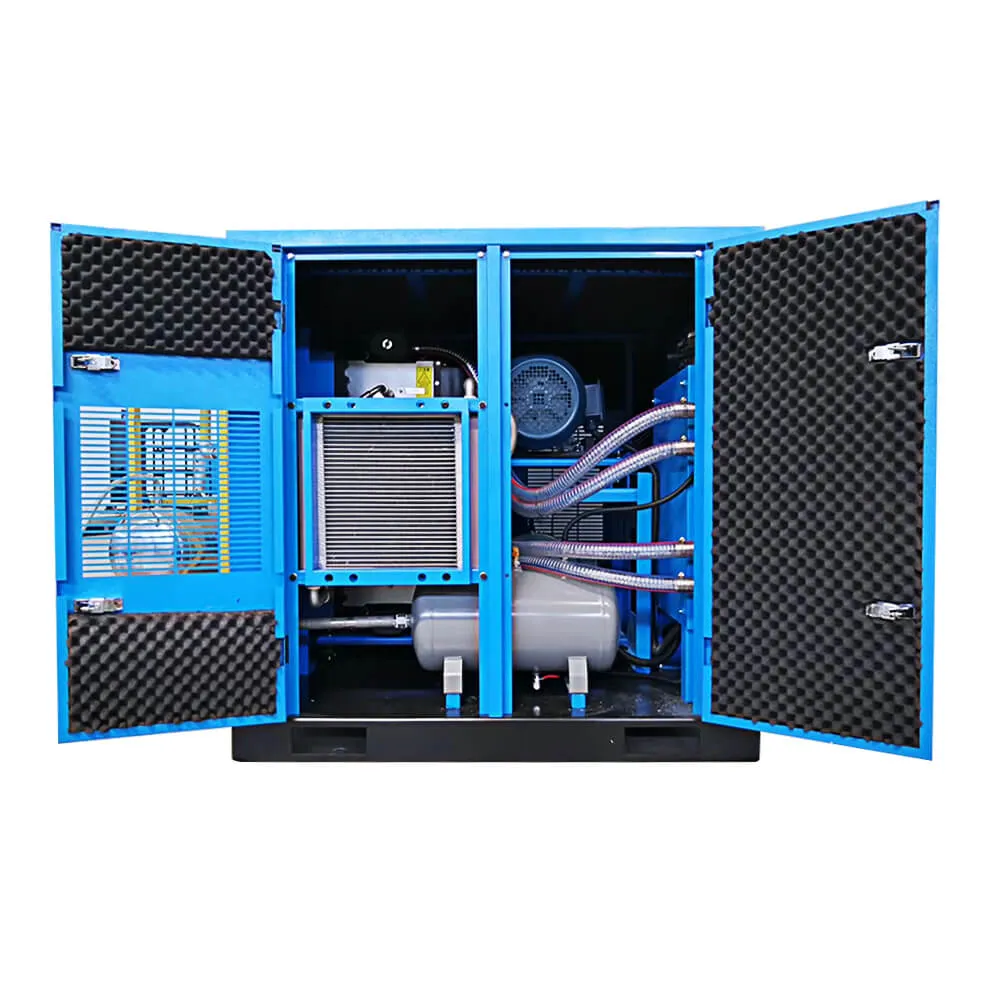
Oil-free twin-screw air compressor for medium-scale PSA oxygen plant in hospital service
Explore Our Full Product Range
Leading manufacturer of oil-free air compressors for oxygen, medical, and industrial applications
Performance Benchmarks: What Good Looks Like in PSA Plant Air Compressors
Performance benchmarks for air compressors in PSA oxygen plant service help buyers evaluate competing proposals and set realistic performance guarantees in supply contracts. The following benchmarks reflect industry best practice for each compressor technology as used in PSA oxygen service.
Specific Power
Best-in-class oil-free scroll compressors achieve 5.5-6.5 kW per 100 L/min of air delivery at 6 bar. Oil-free screw compressors at large scale achieve 4.5-5.5 kW per 100 L/min at 7 bar. Values significantly above these benchmarks indicate below-average efficiency.
MTBF (Mean Time Between Failures)
Well-maintained oil-free scroll compressors in PSA service achieve MTBF exceeding 20,000 hours. Oil-free screw compressors with proper maintenance achieve 40,000+ hours between major overhauls. MTBF values should be guaranteed in the supply contract.
Oil Carryover
Verified Class 0 performance means measured oil carryover of effectively zero (under 0.01 mg/m3 by ASME PTC 9 or equivalent test method). Request third-party test certificates, not just supplier statements.
Discharge Temperature
After integrated aftercooling, discharge temperature should be within 8-15 degrees C of ambient. Higher temperature differentials indicate inadequate aftercooler sizing.
When issuing a tender for PSA oxygen plant air compressors, always include specific performance guarantee clauses for oil carryover, specific power, and noise level with agreed test methods. General quality statements are not enforceable.