
The Role of Air Compressors in Oxygen Concentrator Systems
An oxygen concentrator operates by drawing ambient air, compressing it, and passing it through zeolite molecular sieve beds that selectively adsorb nitrogen — leaving an oxygen-enriched product stream. The air compressor for oxygen concentrator service is therefore the heart of the entire PSA oxygen generation system, and its performance directly determines the purity, flow rate, and reliability of the oxygen output.
The air compressor for oxygen concentrator application differs from a standard compressed air supply in one fundamental way: because its output feeds directly into a process that ultimately delivers oxygen to medical patients or industrial processes, absolute oil-free operation is not merely preferred — it is mandatory. Any oil contamination of the zeolite sieve beds permanently reduces their nitrogen adsorption capacity, dropping oxygen purity and shortening sieve life.
The air compressor for oxygen concentrator service must be Class 0 oil-free per ISO 8573-1. This is a hard technical requirement, not a preference. Oil-lubricated compressors with coalescing filters do not meet this standard for PSA oxygen concentrator service.
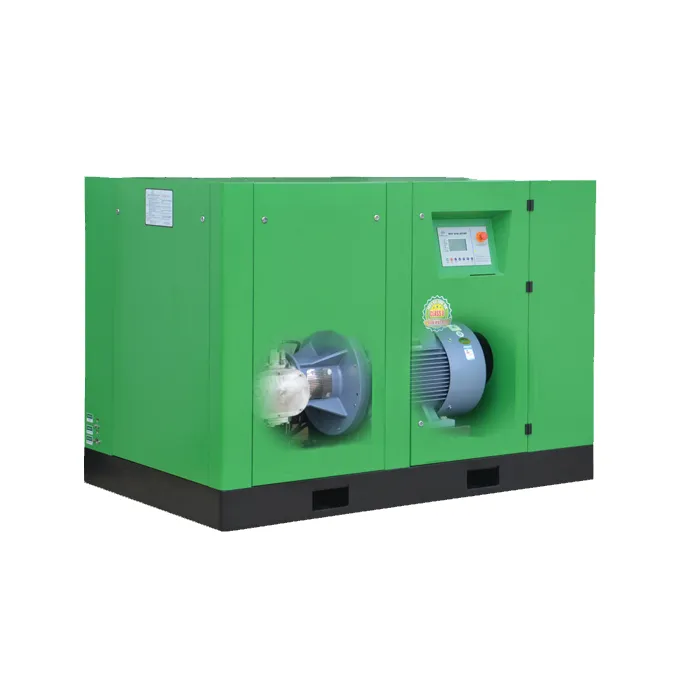
Oil-free air compressor integrated with PSA oxygen concentrator — the foundation of reliable O2 generation
Key Specifications for Air Compressors in Oxygen Concentrators
| Parameter | Specification |
|---|---|
| Inlet flow rate | 3-5 Nm3 of feed air per Nm3 of product oxygen — varies by sieve bed design |
| Discharge pressure | Typically 4-6 bar for small units, up to 8 bar for larger PSA systems |
| Oil content at outlet | Class 0 per ISO 8573-1: effectively 0 mg/m3 detected oil |
| Water content at outlet | Class 2 or better per ISO 8573-1: dewpoint below -40 degrees C |
| Particle content | Class 1 or 2 per ISO 8573-1 for compressor outlet |
| Noise level | Under 65 dBA for medical facility installation (acoustic enclosure often added) |
| Duty cycle | Continuous — 24 hours/day, 365 days/year for hospital oxygen plants |
| Redundancy | N+1 configuration recommended for critical medical oxygen applications |
Technology Options for Oxygen Concentrator Air Compressors
Oil-Free Scroll
The most widely used technology for small to medium oxygen concentrators (up to 30 L/min O2 output). Inherently oil-free, low vibration, low noise, and proven in medical device applications worldwide.
Oil-Free Reciprocating
Cost-effective option for small concentrators and laboratory oxygen generators. Higher noise and vibration than scroll, but lower initial cost. Suitable for non-critical or industrial applications.
Oil-Free Twin Screw
Preferred for large PSA oxygen plants (100+ Nm3/h O2 output). Continuous duty, high flow, excellent energy efficiency at part load with variable frequency drive control.
Oil-Free Rotary Vane
Some smaller oxygen concentrators use rotary vane compressors in oil-free configurations. Generally lower pressure capability than scroll but very compact.
Matching Air Compressor Capacity to Oxygen Concentrator Output
The relationship between air compressor capacity and oxygen concentrator output is governed by the PSA process oxygen recovery ratio. This ratio — typically 30-40% for standard zeolite PSA systems — means that to produce 1 Nm3/h of 93% purity oxygen, the air compressor must supply approximately 3-4 Nm3/h of clean, dry compressed air at the sieve bed pressure.
A common sizing error is specifying an air compressor for oxygen concentrator service based on nominal concentrator oxygen output without accounting for the inlet conditions under which the concentrator will operate. At high ambient temperatures or high altitudes, the volumetric efficiency of the compressor drops, reducing actual air delivery below the nameplate rating. The compressor must be sized for worst-case operating conditions.
| O2 Output | Required Air Flow | Typical Compressor |
|---|---|---|
| 5 L/min O2 (medical, home) | 15-25 L/min air at 3-5 bar | Small scroll, 150-300W |
| 30 L/min O2 (clinic) | 90-150 L/min air at 4-6 bar | Medium scroll or reciprocating, 0.75-1.5kW |
| 10 Nm3/h O2 (hospital) | 30-50 Nm3/h air at 5-7 bar | Multiple scroll or single screw, 5-10kW |
| 100 Nm3/h O2 (industrial) | 300-500 Nm3/h air at 6-8 bar | Oil-free screw, 45-90kW |
| 500 Nm3/h O2 (plant) | 1,500-2,500 Nm3/h air at 6-8 bar | Oil-free screw, 200-400kW |

PSA oxygen plant air compressor system — sized for 24/7 continuous duty at rated O2 output
Explore Our Full Product Range
Leading manufacturer of oil-free air compressors for oxygen, medical, and industrial applications
Air Treatment After the Compressor: What Your Concentrator Also Needs
An oil-free air compressor for oxygen concentrator service is necessary but not sufficient for optimal PSA system performance. The compressed air must also be dried and filtered before entering the zeolite sieve beds. Moisture is particularly damaging to zeolite — water molecules compete with nitrogen for adsorption sites, reducing both purity and capacity.
Compressed Air Dryer
A refrigerant or desiccant dryer downstream of the air compressor removes moisture to the required dewpoint. For most PSA oxygen concentrators, a refrigerant dryer to 3-7 degrees C pressure dewpoint is the minimum. Cold-climate or medical-grade systems may require desiccant drying to -40 degrees C pressure dewpoint.
Particulate Filtration
A pre-filter before the dryer and a final filter after the dryer ensure particulate matter does not enter the sieve beds. Standard filter grades for PSA oxygen service are 1 micron pre-filter and 0.01 micron final coalescing filter.
Oil Vapor Monitoring
For medical oxygen concentrators, continuous or periodic oil vapor monitoring at the compressor outlet provides assurance of Class 0 compliance. Catalytic oxidation sensors can detect hydrocarbons in the sub-ppm range.
Aftercooler
Most oil-free air compressors include an integrated aftercooler to reduce discharge temperature before the dryer. Verify that the compressor includes an effective aftercooler, or specify a separate aftercooler in the system design.
A complete air treatment system for PSA oxygen concentrator service comprises: oil-free compressor, aftercooler, pre-filter, refrigerant or desiccant dryer, and final particulate filter. Omitting any element risks sieve bed contamination.
Custom and Wholesale Air Compressors for Oxygen Concentrator OEM Supply
OEM manufacturers of PSA oxygen concentrators and medical oxygen generators require compressor modules that integrate seamlessly into their system design. We supply air compressor modules for oxygen concentrator OEM integration across a range of flow rates, pressures, and control interface specifications.
Custom Control Interface
We develop compressor modules with customer-specific control interfaces — from simple relay outputs to Modbus RTU serial communication — for direct integration with the OEM’s system controller.
Integrated Packaging
Compressor, aftercooler, dryer, and filtration can be supplied as a pre-assembled, pre-tested module mounted on a common baseplate. This reduces the OEM’s assembly work and ensures correct system configuration.
Private Label Supply
White-label compressor modules can be branded with the OEM’s nameplate, serial number format, and documentation style for transparent integration into the OEM product.
Regulatory Documentation
We provide full CE documentation, ISO 8573-1 Class 0 test certificates, and ISO 13485 compliance statements for medical device OEM integrations. Custom documentation to customer format is available.