
The Critical Link Between Air Compressor and Oxygen Generator
A PSA oxygen generator is only as good as its feed air compressor. The generator’s zeolite molecular sieves rely on a steady supply of clean, dry, oil-free compressed air at a stable pressure to efficiently separate oxygen from nitrogen. When the air compressor does not match the generator’s requirements — in flow rate, pressure, air quality, or duty cycle — the consequences cascade through the entire oxygen generation system: reduced purity, reduced output, accelerated sieve degradation, and increased operating cost.
Matching an air compressor to an oxygen generator is therefore not a peripheral engineering task. It is the central design decision that determines the entire system’s performance, reliability, and economic viability. This guide provides the framework for making that match correctly.
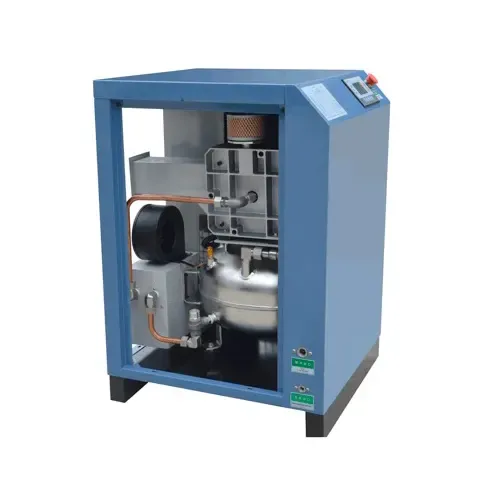
Oil-free air compressor precisely matched to PSA oxygen generator — the foundation of reliable O2 production
Understanding PSA Oxygen Generator Air Requirements
Flow Rate Requirement
PSA oxygen generators consume 3-5 volumes of compressed air for each volume of oxygen produced, depending on the sieve design and target oxygen purity. This air-to-oxygen ratio must be the basis for compressor sizing. Undersizing the compressor starves the generator and reduces output.
Pressure Requirement
PSA sieve beds operate at a specific adsorption pressure — typically 4-7 bar for standard systems. The air compressor must maintain this pressure consistently under all operating conditions. Pressure fluctuation reduces sieve efficiency and oxygen purity.
Oil-Free Requirement
Any oil in the compressed air feed permanently degrades the zeolite sieve material. ISO 8573-1 Class 0 oil-free certification is mandatory. This is the single most important air quality requirement for PSA oxygen generator feed air.
Moisture Requirement
Compressed air moisture damages zeolite sieves and reduces adsorption capacity. The air dryer downstream of the compressor must reduce pressure dewpoint to -40 degrees C or lower for most oxygen generator applications.
Temperature Requirement
High feed air temperature reduces PSA cycle efficiency. Compressor aftercooling should bring discharge temperature within 10 degrees C of ambient. Air entering the sieve beds above 40 degrees C significantly reduces oxygen output.
Pulsation
Reciprocating air compressors generate pressure pulsations that can disturb zeolite granules in sieve beds. Buffer vessels or pulsation dampeners between the compressor and generator are required for reciprocating machines.
Sizing the Air Compressor for an Oxygen Generator: Step-by-Step
Accurate compressor sizing requires a clear oxygen production target and an understanding of the specific PSA generator design’s air-to-oxygen ratio. The following sizing example illustrates the methodology.
| Sizing Step | Value and Calculation |
|---|---|
| Target O2 output | 10 Nm3/h at 93% purity |
| Generator air-to-O2 ratio | 4:1 (typical for standard 93% purity PSA) |
| Required air flow (calculated) | 10 x 4 = 40 Nm3/h at standard conditions |
| Ambient temperature derating (40C) | 40 Nm3/h / 0.92 (temperature factor) = 43.5 Nm3/h |
| Altitude derating (500m) | 43.5 / 0.95 (altitude factor) = 45.8 Nm3/h |
| Service factor (10% margin) | 45.8 x 1.10 = 50.4 Nm3/h |
| Selected compressor rating | 55 Nm3/h at 6 bar (standard compressor size above requirement) |
Always size the air compressor for the oxygen generator based on worst-case ambient conditions at the installation site, not standard conditions. A compressor correctly sized for standard conditions may be 15-20% undersized in a hot, high-altitude installation.

Engineering sizing worksheet for air compressor selection matched to PSA oxygen generator output target
Technology Selection: Air Compressor for Oxygen Generator
Oil-Free Scroll (Small-Medium Scale)
Best choice for oxygen generators producing up to 30 Nm3/h O2. Inherently oil-free, low vibration, low maintenance, compact. Multiple scroll compressors can be paralleled for larger generators with N+1 redundancy.
Oil-Free Twin Screw (Medium-Large Scale)
Optimal for generators producing 30-500 Nm3/h O2. High efficiency at continuous duty, compatible with VFD control, robust for industrial environments. Requires more maintenance than scroll but handles larger flow rates in a single machine.
Oil-Free Reciprocating (Medium Scale with High Pressure)
Used where the PSA generator requires higher feed pressure (above 8 bar). Higher noise and vibration than scroll or screw, but capable of the pressures that some specialized sieve designs require.
Explore Our Full Product Range
Leading manufacturer of oil-free air compressors for oxygen, medical, and industrial applications